

The jobs market is cooling down. The unemployment rate in August was 4.3 percent. In the pandemic, the unemployment rate peaked at 14.8 percent, but fell to 3.4 percent in April 2023.
While the modest tick up from 3.4 to 4.3 percent isn’t great, some of the recent payroll data hasn’t met expectations either. The most recent monthly reading showed that just 22k jobs were created, less than expectations.
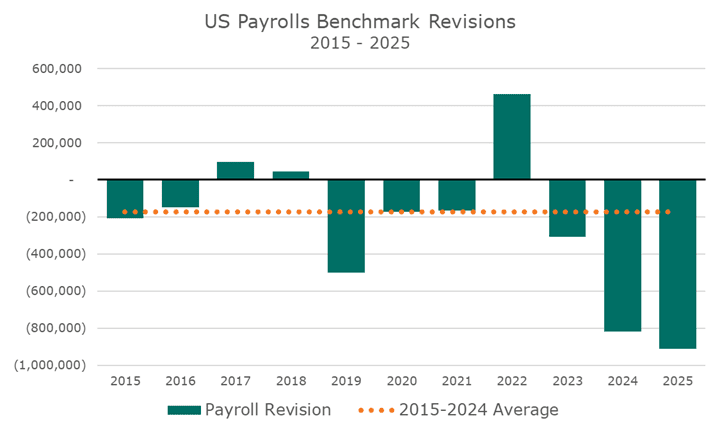
Worse still is that the Bureau of Labor Statistics (BLS) regularly publishes revisions as they get better data, and they estimated that they overestimated the 12 months ending in March by 911k jobs. Wow, that’s a major revision.
The chart below shows the revisions over the previous decade, just to give a sense of what’s ‘normal.’ In seven of the previous ten years, the revisions were to the downside, and only one was substantially higher than previously calculated. In terms of frequency, the downward revision isn’t so bad.
In terms of magnitude, it isn’t nice at all. In the ten years ending in 2024, the average revision was -172.4k (and the terrible 2024 reading highly influenced that average). That makes the 2025 reading more than five times worse than the previous year’s average. Double wow.
The stock and bond markets didn’t respond too negatively because it raised the likelihood that the Federal Reserve would start to lower interest rates.
To me, that feels a little bit like missing the forest through the trees, since the labor market is essentially the foundation of economic activity. Consumer spending accounts for about 70 percent of the economy, and people need to work to have money to spend.
Still, I suppose a cooling jobs picture doesn’t immediately spell trouble, but it does warrant close attention.

David is a trusted advisor to 50 families, delivering comprehensive financial solutions, including financial planning, investment management, cash management, tax planning, estate planning, and charitable giving. As Chief Investment Officer, he leads the Investment Committee and the research and trading team. His team continuously evaluates investment strategies and securities, working closely with Portfolio Managers to implement them effectively.